How Much Sunscreen Should You Apply to Your Face?
Most people apply far less sunscreen than the amount used to measure SPF in lab testing. Here is the actual standard, what it looks like in practice, and what happens to your protection when you fall short.
By GlowUp Guides Editorial Team · Updated May 2026 · 7 min read
Quick Answer
Bottom line: Apply about 1/4 teaspoon to the face — that's the dose SPF is actually tested at. Most people use 20–50% less, which means the real protection they're getting is much lower than the label says.
- Face dose: ~1/4 teaspoon (1.25 ml); neck and ears each need a separate application on top of that
- Applying half the tested dose can reduce SPF 50 to an effective SPF of roughly 7
- Reapply every 2 hours outdoors; never mix sunscreen into your moisturizer — it dilutes the UV filter concentration
Key Takeaways
- SPF is tested at 2 mg/cm² — roughly 1/4 teaspoon (1.25 ml) for the face alone. Most people apply 20–50% of that amount.
- Applying half the tested dose can reduce SPF 50 to an effective SPF of roughly 7, not 25 — the relationship between dose and protection is non-linear.
- The 1/4 teaspoon covers the face only. The neck, ears, and chest each need a separate application.
- Mixing sunscreen with moisturizer dilutes UV filter concentration and lowers the effective SPF. Apply each product as its own separate layer.
- Reapplication every two hours outdoors is part of what makes the labeled SPF meaningful in real-world use.
- Mineral sunscreens often leave white cast at full-dose amounts — a common reason people under-apply them.
Key Terms
Where the 1/4 Teaspoon Standard Comes From
Every SPF rating on a sunscreen label is measured in a controlled lab setting using a standardized dose: 2 milligrams of sunscreen per square centimeter of skin (2 mg/cm²). This dose is set by the FDA, Health Canada, and ISO testing guidelines — and it is the reference point for every SPF number printed on a product label.
For the average adult face — roughly 500–600 cm² of surface area — that dose works out to approximately 1,000–1,200 mg, or about 1–1.25 ml of product. In practical terms, that is close to 1/4 teaspoon.
Sunscreen is applied last in the morning routine, after moisturizer and before any makeup. If you are still working out where each product goes, the guide to how to layer skincare products covers the correct sequence for AM and PM routines step by step.
The 1/4 teaspoon is a minimum for the face only. The neck, ears, and chest each require additional product — a common guideline for the full face and neck combined is closer to 1/2 teaspoon total.
What Happens When You Apply Less
Research consistently shows that most people apply between 20% and 50% of the tested dose in real-world use. The practical consequence: a sunscreen labeled SPF 50 may deliver an effective SPF of 15–25 when applied at typical amounts.
The relationship between dose and protection is not linear. Research published in the British Journal of Dermatology has found that applying half the recommended dose can reduce protection to approximately the square root of the labeled SPF — so SPF 50 applied at half the dose delivers roughly SPF 7, not SPF 25.
The practical implication: applying a higher-SPF product generously is likely to give you more real-world protection than applying a lower-SPF product at a comfortable amount.
If you are looking for a formula that is easier to apply at full coverage without white cast or a greasy finish, the best sunscreens for sensitive skin guide covers options by formula type and skin concern.
What 1/4 Teaspoon Actually Looks Like
The 1/4 teaspoon guideline is useful but abstract. Here are three practical reference points you can use without measuring:
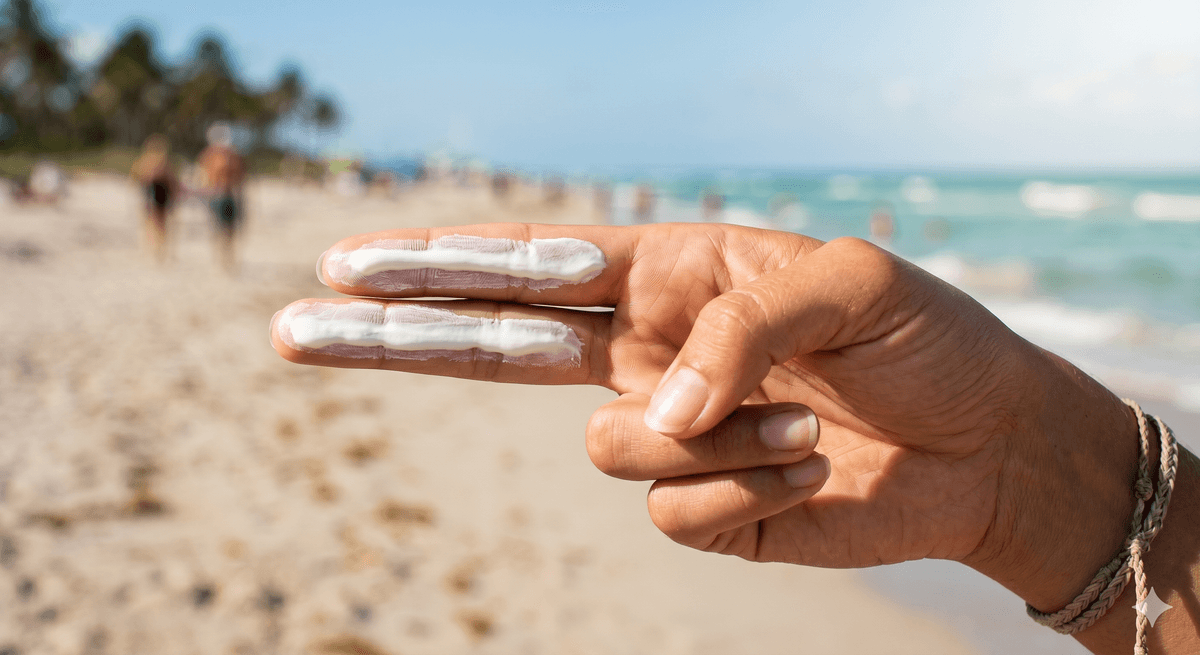
Two finger-lengths (the two-finger rule): Squeeze sunscreen along the length of your index and middle fingers from tip to first knuckle. This approximates 1/4 teaspoon for most adults and is the most commonly cited visual reference.
A nickel-sized dollop (for thicker formulas): A cream or lotion dollop roughly the diameter of a nickel gives a comparable volume. Fluid formulas will look larger on the hand at the same volume.
Coverage feel: At the correct amount, most sunscreens require deliberate blending to spread evenly. If your sunscreen disappears with minimal effort, you are likely applying too little.
If the full amount feels heavy in one pass, apply in two thinner layers — let the first absorb briefly before adding the second. This improves coverage around the hairline and nose without the heavy feel. For a full picture of where sunscreen sits in your morning routine, the beginner skincare routine guide covers product order from cleanser to SPF.
Application amount is the biggest factor in real-world SPF — but several other habits also reduce the protection you receive. Here is what to do and what to avoid:
Do / Don't
Do
- Apply sunscreen as a separate step after moisturizer, before makeup
- Cover ears, hairline, eyelids, and the back of the neck on every application
- Reapply every two hours when spending time outdoors
- Apply chemical sunscreens 15–20 minutes before sun exposure so UV filters can bind to skin
- If blending is effortless, apply more — that likely means you are under-applying
Don't
- Mix sunscreen with moisturizer before applying — this dilutes the UV filter concentration
- Skip ears, hairline, and eyelids — these high-exposure areas are frequently missed
- Apply once and assume all-day protection — UV filters degrade with sun exposure and physically wear off
- Rely solely on SPF powder or setting spray for reapplication — these rarely deliver a full dose
- Choose a higher SPF and apply less of it, assuming the number compensates for volume
How to Reapply Over Makeup
Reapplication over makeup is one of the most practical challenges of daily sun protection. Full reapplication — blotting, applying sunscreen, then touching up makeup — gives the most reliable protection but is not always practical during a workday.
If you use vitamin C serum in the morning, sunscreen still goes on last in the AM routine — reapplication follows the same order, with SPF as the final layer before any makeup touch-up.
SPF setting sprays: Practical for top-up application during the day but typically deliver lower doses than a full application. Use as a supplemental layer, not a replacement for the morning sunscreen application.
SPF powder: Easy to apply over makeup without disturbing it. Achieving a full 2 mg/cm² dose from powder requires more product than most people apply — treat it as supplemental protection, not a full reapplication.
Cushion compacts and reapplication pads: Pre-soaked cushions allow a thin, even layer to be pressed on without rubbing — the most makeup-compatible option for top-up SPF. Widely available in Korean beauty formats.
For extended outdoor time, the most reliable method is to blot the face first, apply a full dose of sunscreen by patting (not rubbing), then reapply makeup if needed.
How to Choose (Based on Your Case)
If
You apply sunscreen daily but your skin still burns or tans more than expected
Check your application amount first
Because: Most people apply 20–50% of the tested dose. Increasing to 1/4 teaspoon — roughly two finger-lengths — may close the gap between labeled SPF and real-world protection.
If
You mix sunscreen and moisturizer together before applying
Switch to applying each product as a separate layer
Because: Mixing dilutes the UV filter concentration in the blend, which lowers the effective SPF regardless of how much of the mixture you apply.
If
You use mineral sunscreen but avoid full coverage because of visible white cast
Try applying in two thin layers instead of one thick one
Because: Two thin layers blend more easily and can reach full coverage with less visible white cast — same protection, more wearable result.
If
You want a sunscreen formula that makes full-dose application more comfortable
See the sunscreen guide for formula options by skin type
Because: A lightweight, tinted, or fluid formula may make consistent full-dose application easier — particularly for oily or acne-prone skin.
Frequently Asked Questions
Sources
- [1]American Academy of Dermatology (AAD). Sunscreen FAQs. View source
- [2]U.S. Food and Drug Administration (FDA). Sunscreen: How to Help Protect Your Skin from the Sun. View source
- [3]Skin Cancer Foundation. Sunscreen: Your Defense Against Skin Cancer. View source
Bottom Line
The SPF on your sunscreen only reflects what you get when you apply the tested amount — about 1/4 teaspoon for the face. Applying less, mixing with other products, or skipping reapplication all reduce the protection you actually receive. The simplest way to close that gap: apply a generous layer that takes real blending to spread evenly, cover the ears and hairline, and reapply every two hours outdoors. Consistent application at the right amount matters more than chasing a higher SPF number.
Keep Reading

Retinol + Sunscreen: The Combo You Can't Skip in Summer
Retinol doesn't actually make your skin sun-sensitive — but skip SPF and you undo everything it's doing. Why the pair is non-negotiable, summer included.
5 Skincare Ingredients You Should Never Wear in the Sun (And the One Everyone Gets Wrong)
'Never wear in the sun' means three different things. Here's which ingredients truly need daytime avoidance, which just need SPF, and the one myth to drop.
Best Sunscreens for Sensitive Skin on Amazon
Fragrance-free, dermatologist-approved sunscreen picks for sensitive, acne-prone, and eczema-prone skin — from $13 to $45.