How Often Should You Use an LED Mask? (And When You’ll See Results)
The frequency question has an answer in the trial literature. It is lower than the marketing suggests, and the timeline is longer.
Updated August 2026 · 9 min read
Quick Answer
Bottom line: Most controlled trials that reported results used an LED mask two to three times a week, and many at-home masks are built around shorter, near-daily sessions instead. Pick the frequency that matches your goal, follow the instructions for your specific device, and hold it for 8 to 12 weeks or longer. More sessions do not mean faster results — photobiomodulation follows a biphasic dose response.
- Two to three times a week is the frequency most controlled trials of red-light masks used — and a 2025 sham-controlled trial found three weekly sessions did not significantly outperform two
- Blue and blue-red regimens for breakout-prone skin ran anywhere from twice weekly to daily in published studies, with lesion-count changes emerging around weeks 4 to 8
- Photobiomodulation has a biphasic dose response: past the optimal dose, extra exposure is not known to add benefit and can leave skin transiently dry or tight
- Consistency across 8 to 16 weeks is what every successful protocol shares — not a higher irradiance number on the box
Key Takeaways
- Two to three sessions a week is the frequency most controlled trials of red-light masks used. Evidence: moderate — the samples are small and some trials are industry-funded.
- For breakout-prone skin, published blue and blue-red regimens ranged from twice weekly to daily. Evidence: moderate to strong, and the daily protocols are the older ones.
- Timeline: appearance-level change was measured from around 4 weeks in these trials, with firmness-type endpoints assessed across 8 to 12 weeks. Evidence: moderate — the endpoints are heterogeneous.
- Photobiomodulation follows a biphasic dose response, so more frequent use is not automatically faster or stronger. Evidence: strong as a principle, though the optimal dose for any specific consumer mask is not established.
- Adherence over 8 to 16 weeks is what the successful protocols have in common. The irradiance arms race between brands is GlowUpGuides analysis, not a cited trial finding.
Short answer: the controlled trials that reported measurable change in the appearance of skin mostly ran two to three sessions a week. Many at-home masks are instead designed around shorter, near-daily sessions, which is why device instructions and trial protocols often disagree. Both can be reasonable — the manufacturer knows the per-session dose of that specific mask, and you do not.
What the evidence does not support is the instinct behind the question. Doubling the sessions is not known to halve the timeline. If you are still deciding whether to buy one at all, start with what the evidence says about LED masks overall.
What “How Often” Actually Depends On
There is no single frequency for LED masks because there is no single mechanism. Three things move the answer: your goal, the wavelength involved, and the dose the device delivers per session.
Red and near-infrared light work through photobiomodulation. Hamblin’s mechanistic reviews describe absorption primarily by cytochrome c oxidase in mitochondria, raising ATP and downstream signalling that supports fibroblast and collagen activity. Blue light around 415 nm works differently — it acts on porphyrins produced by Cutibacterium acnes. The mechanisms are well characterised. The size of the cosmetic effect is the variable part.
- Goal: photoaging endpoints (fine lines, firmness, texture) and inflammatory acne endpoints come from different trials with different schedules. They do not share a frequency.
- Wavelength: red at roughly 630–660 nm and near-infrared around 830 nm reach the dermis; blue at roughly 415 nm is absorbed superficially. Different targets, different protocols.
- Delivered dose: irradiance in mW/cm² multiplied by session length gives fluence in J/cm². Two masks labelled “red light” can deliver very different energy in the same 10 minutes.
That third factor is why “three times a week” is meaningless without the device attached to it. For the mechanism side of red versus blue in more depth, see how red and blue light differ and which one you need.
How Often for Fine Lines and Firmness
For the appearance of wrinkles and firmness, the trials cluster at two to three sessions per week. The most directly relevant one tested exactly that comparison.
A 2025 randomised, sham-controlled, double-blind trial in Lasers in Medical Science enrolled 95 women aged 45 to 60 and used a 660 nm red LED mask at 6.4 mW/cm², 8.05 J/cm² per session, 21 minutes, for four weeks. One group received three weekly applications (12 sessions), another two weekly applications (8 sessions), and the control group received sham light twice weekly.
The finding that matters for this article: the number of sessions did not significantly alter the results. Both active groups showed significant reductions in measured glabellar and right periorbital wrinkle length compared with the sham group (p < 0.001), and both reported significantly higher satisfaction than control. The authors concluded that two weekly sessions were sufficient. Worth reading precisely: on the blinded Wrinkle Assessment Scale, no significant differences were found among groups — the separation came from image-based wrinkle-length measurement and participant satisfaction, not from the clinical grading scale.
The longer-horizon trial ran at the same frequency. Couturaud and colleagues (2023, Skin Research and Technology) treated facial skin with a 630 nm LED mask at 15.6 J/cm² over 12 minutes, twice weekly for three months, with endpoints assessed at day 28, 56 and 84. It is a useful anchor for the multi-month picture, with one caveat stated plainly: the author list includes a Lucibel affiliation, so this is an industry-linked trial rather than an independent one.
Both trials describe what happened in their study populations over a fixed protocol. Neither is a prediction of what any individual reader’s skin will do, and an LED mask sits alongside a retinoid used correctly and daily sunscreen applied properly, never in place of them.
How Often for Breakout-Prone Skin
The acne-side protocols run more frequently than the photoaging ones, and they span a much wider range: from twice weekly up to daily, depending on the study.
At the daily end sits Papageorgiou, Katsambas and Chu (2000), which randomised 107 people to blue light at 415 nm, mixed blue and red at 415 and 660 nm, cool white light, or 5% benzoyl peroxide — 15 minutes daily for 12 weeks. In that trial’s blue-red arm, mean improvement in inflammatory lesions reached 76% (95% CI 66–87). That figure belongs to that protocol, in that study population, over 12 weeks of daily sessions with a stated dose. It is not a number any mask on a shelf can promise.
At the twice-weekly end sits a 2005 open study of narrowband blue light at 409–419 nm and 40 mW/cm²: 30 subjects, eight treatments over four weeks, sessions of 10 or 20 minutes. An overall reduction in inflammatory lesions was observed by week 5, with statistically significant decreases in inflamed lesion counts at week 8 that continued to week 12. Effect on comedones was minimal, and side effects were mild and self-resolving.
Both trials measured inflammatory lesion counts in enrolled participants. That is a narrower statement than “clears acne,” and it is the only statement the evidence supports. Light therapy is studied alongside conventional acne treatment, not as a replacement for it — and if breakouts are moderate or scarring, that is a dermatologist conversation rather than a device decision.
The practical read: for breakout-prone skin the studied range is genuinely wide, so the manufacturer’s instruction for your specific mask is the better guide than any single trial schedule.
Can You Overdo It?
Yes — and this is the part the category is least honest about. Photobiomodulation does not respond linearly to exposure. It follows a biphasic dose response, an Arndt–Schulz-shaped curve described in Huang and colleagues’ 2011 Dose-Response review.
Below the effective window, nothing measurable happens. Within it, you get the response. Above it, the response is suppressed rather than amplified — more energy delivered, less effect obtained. So the intuition that an extra session must be doing something extra has the biology backwards.
| Dose region | What the curve predicts |
|---|---|
| Below the window | Too little energy to produce a measurable response — sessions too short, or irradiance too low |
| Inside the window | The region where trial protocols sit. Modest doses, repeated on a schedule |
| Above the window | Response suppressed rather than increased. Extra exposure is not known to add benefit |
Two honest limits on this. First, the biphasic principle is strongly established, but the precise optimal dose for a given consumer mask is not — no one has mapped that curve for the device in your bathroom. Second, the adverse effects reported in these trials were mild: transient dryness, tightness, redness, or discomfort during the session. Overdoing it is more likely to waste your time than to harm your skin.
That said, safety is individual and this article cannot assess yours. If you are pregnant, take a photosensitising medication such as isotretinoin or doxycycline, live with melasma, or have a photosensitive or retinal condition, check with a clinician before starting light therapy at any frequency.
When You’ll Actually See Results
Here is the timeline as the trials measured it, not as a promise. Every row describes what was assessed in a study population at that point — endpoints in enrolled participants, on a fixed protocol.
| Timeframe | What the trials measured | Confidence |
|---|---|---|
| Weeks 1–3 | No endpoint in this evidence base is assessed here. Nothing published supports change this early | Strong (as an absence) |
| Weeks 4–5 | First assessment points. Wrinkle-length measures at 4 weeks in the 2025 red-light trial; overall reduction in inflammatory lesions noted by week 5 in the 2005 blue-light study | Moderate |
| Weeks 8 | Statistically significant decreases in inflamed lesion counts in the 2005 study; day-56 assessment point in the 2023 red-light trial | Moderate to strong |
| Weeks 12 (3 months) | Acne improvement continued to week 12 in both acne trials; firmness-type endpoints assessed at day 84 in the 2023 trial | Moderate |
| Beyond 12 weeks | Largely unmeasured in this set of consumer-mask trials. Whether gains hold, plateau, or fade without continued sessions is not established here | Weak — evidence gap |
The pattern across both concerns: something is assessable around week 4, the clearer separations arrive around week 8, and the multi-month endpoints run to 12 weeks. Which is the real answer to “how long” — you are committing to a season, not a fortnight.
Building a Frequency You’ll Keep
This section is GlowUpGuides analysis rather than a cited trial finding, and it is worth labelling as such. It follows from two things that are cited: the biphasic dose response, and the length of every protocol above.
Every trial that reported a result shares one feature — the schedule was completed, over 4 to 12 weeks, without gaps. None of them share a device power rating. The 2025 trial ran at 6.4 mW/cm², a modest figure, and still separated from sham. Read alongside the biphasic curve, the implication is that the irradiance arms race between brands is largely a marketing construct: past the effective window, a bigger number is not buying a bigger effect.
What that means in practice:
- Choose the frequency you can hold for three months, not the maximum the device permits. Two weekly sessions completed beats four attempted.
- Anchor the session to something already fixed in your week rather than to motivation — the protocols worked because they were scheduled.
- Treat a missed session as a missed session, not a debt. There is no evidence that doubling up afterwards recovers anything.
- Judge at week 8 and week 12, not week 2. Assessing too early is the most common reason people abandon a protocol that was still on schedule.
- Spend on disclosure rather than wattage: a brand that publishes irradiance and per-session fluence is telling you what dose you are getting.
One more framing worth keeping: at-home masks run at lower irradiance than in-clinic systems, and some consumer devices are FDA-cleared rather than FDA-approved. The consumer-LED evidence base is thinner than the clinical one, with several small and industry-funded studies in it.
Dermatologists working with these devices land in a similar place. Dr. Heather D. Rogers, MD, FAAD, a double board-certified dermatologist, writes that home devices are not replacements for professional lasers or energy-based devices but work well for maintenance, that most studies show measurable improvements after 4 to 12 weeks of consistent use, and — the part worth underlining — that she prefers lower-irradiance devices used for longer periods over extremely powerful ones. That is practice guidance rather than trial data, but it points the same direction the dose-response curve does.
If price is the deciding factor, what you actually get under $150 is the more useful question than how many times a week to use it.
How to Choose (Based on Your Case)
If
Fine lines, firmness, or general prevention
Two to three sessions a week
Because: This is the frequency the red-light photoaging trials used, and the 2025 sham-controlled trial concluded two weekly sessions were sufficient — three did not significantly outperform two.
If
Breakout-prone skin
Follow the device instructions, within a twice-weekly to daily range
Because: Published blue and blue-red protocols span that entire range, from eight sessions over four weeks up to 15 minutes daily for 12 weeks. The manufacturer knows the per-session dose of your mask; a trial schedule for a different device does not transfer.
If
Both concerns at once
Alternate, or use a red-and-blue device on its stated programme
Because: Combined blue-red in a single session is the studied approach in the cornerstone acne trial. What no trial supports is stacking two separate sessions in one day to cover both goals.
If
Tempted to add sessions because progress feels slow
Hold the schedule and reassess at week 8
Because: The biphasic dose response means extra exposure past the optimal dose is not known to add benefit. The trial endpoints that separated from sham were assessed at weeks 4, 8 and 12, not earlier.
If
Pregnant, on photosensitising medication, melasma-prone, or living with a photosensitive or retinal condition
Check with a clinician before starting
Because: This article cannot assess safety for an individual, and these are the situations where the frequency question is a medical one rather than a routine one.
Whichever frequency you land on, the manufacturer’s guidance for your specific mask takes precedence over any protocol quoted here — because it is the only instruction written for the dose your device actually delivers.
Frequently Asked Questions
Is it OK to use an LED mask every day?
Daily use appears in the acne literature — the cornerstone 2000 blue-red trial ran 15 minutes daily for 12 weeks — so daily protocols are studied. What daily use is not is automatically better: photobiomodulation follows a biphasic dose response, and a 2025 sham-controlled trial found three weekly sessions did not significantly outperform two. Follow the manufacturer's instructions for your specific mask, since per-session dose differs between devices.
How long until I see results from an LED mask?
Published protocols run in weeks and months, not days. In a 2005 open study of narrowband blue light, an overall reduction in inflammatory lesions was noted by week 5, with statistically significant decreases at week 8 that continued to week 12. Red-light photoaging endpoints were measured at 4 weeks in one 2025 trial and across three months in a 2023 study. Nothing in this literature supports visible change within a week.
Can you use an LED mask too much?
Photobiomodulation follows a biphasic dose response, described in a 2011 review by Huang and colleagues: below the effective window nothing happens, and above it the response is suppressed rather than amplified. Extra sessions past the optimal dose are not known to add benefit, and reported adverse effects in these trials were mild — transient dryness, tightness, or redness. The precise sweet spot for any given consumer mask has not been established.
Should I use an LED mask in the morning or at night?
No trial in this evidence base compared morning against evening use, so there is no published basis for preferring one. What the protocols do share is a fixed slot repeated over 8 to 12 weeks or longer. Pick the time of day you will actually keep, and apply the mask to clean, dry skin.
Do I use an LED mask before or after serums?
Trial protocols applied light to clean, bare skin, so that is the only sequencing the evidence speaks to. Serums and moisturiser afterwards is the practical order. Anything that raises light sensitivity — certain topicals and oral medications — is worth raising with a clinician before starting light therapy at any frequency.
Does a more powerful mask work faster?
Not necessarily. The biphasic dose response means more delivered energy is not linearly more effect, and the protocols that produced published results used modest doses — roughly 8 J/cm² per session in a 2025 red-light trial, and 15.6 J/cm² over 12 minutes in a 2023 study. At-home masks also run at lower irradiance than in-clinic systems, so a higher consumer spec is not equivalent to a professional device.
Sources
- [1]Huang Y-Y, Sharma SK, Carroll J, Hamblin MR. Biphasic dose response in low level light therapy — an update. Dose-Response. 2011;9(4):602–618. View source
- [2]Hamblin MR. Mechanisms and applications of the anti-inflammatory effects of photobiomodulation. AIMS Biophysics. 2017;4(3):337–361. View source
- [3]Hamblin MR. Mechanisms and mitochondrial redox signaling in photobiomodulation. Photochem Photobiol. 2018;94(2):199–212. View source
- [4]Bragato EF, Paisano AF, Pavani C, et al. Role of photobiomodulation application frequency in facial rejuvenation: randomized, sham-controlled, double-blind, clinical trial. Lasers Med Sci. 2025;40(1):170. View source
- [5]Couturaud V, Le Fur M, Pelletier M, Granotier F. Reverse skin aging signs by red light photobiomodulation. Skin Res Technol. 2023;29(7):e13391 — note: authors include a Lucibel affiliation, so this trial is industry-linked. View source
- [6]Papageorgiou P, Katsambas A, Chu A. Phototherapy with blue (415 nm) and red (660 nm) light in the treatment of acne vulgaris. Br J Dermatol. 2000;142(5):973–978. View source
- [7]Morton CA, Scholefield RD, Whitehurst C, Birch J. An open study to determine the efficacy of blue light in the treatment of mild to moderate acne. J Dermatolog Treat. 2005;16(4):219–223. View source
- [8]Rogers HD, MD, FAAD. Red light therapy masks: a dermatologist's guide to Celluma and more — board-certified dermatologist practice guidance, cited here as corroboration rather than primary evidence. View source
Final Thoughts
Two to three sessions a week is the honest default for fine lines and firmness, because that is what the controlled trials used — and the one trial that directly compared two against three found the extra session did not significantly change the outcome. For breakout-prone skin the studied range is wider, from twice weekly to daily, which is exactly why the instructions for your specific device matter more than any single protocol.
Then hold it. Change was assessed from around week 4 in these trials, separated more clearly around week 8, and ran out to 12 weeks — so the realistic unit of commitment is two to three months, not two to three weeks. Adding sessions is not a shortcut through that, and the biphasic dose response is the reason why. To compare specific models on what they disclose about dose, our LED face mask comparison covers wavelengths, treatment times and published specs.
This article is for informational purposes and is not medical advice. Individual results vary. Consult a qualified healthcare professional before starting light therapy, particularly if you are pregnant, take photosensitising medication, or have a diagnosed eye or skin condition.
Related Reading
The rest of the LED cluster, in the order most people read it.
Keep Reading
Budget LED Face Masks Under $150: Do the Cheap Ones Work?
A cheap LED mask can work in principle — dose is irradiance × time. The catch: under $150, the specs don't let you compute the dose. Here's what we found.
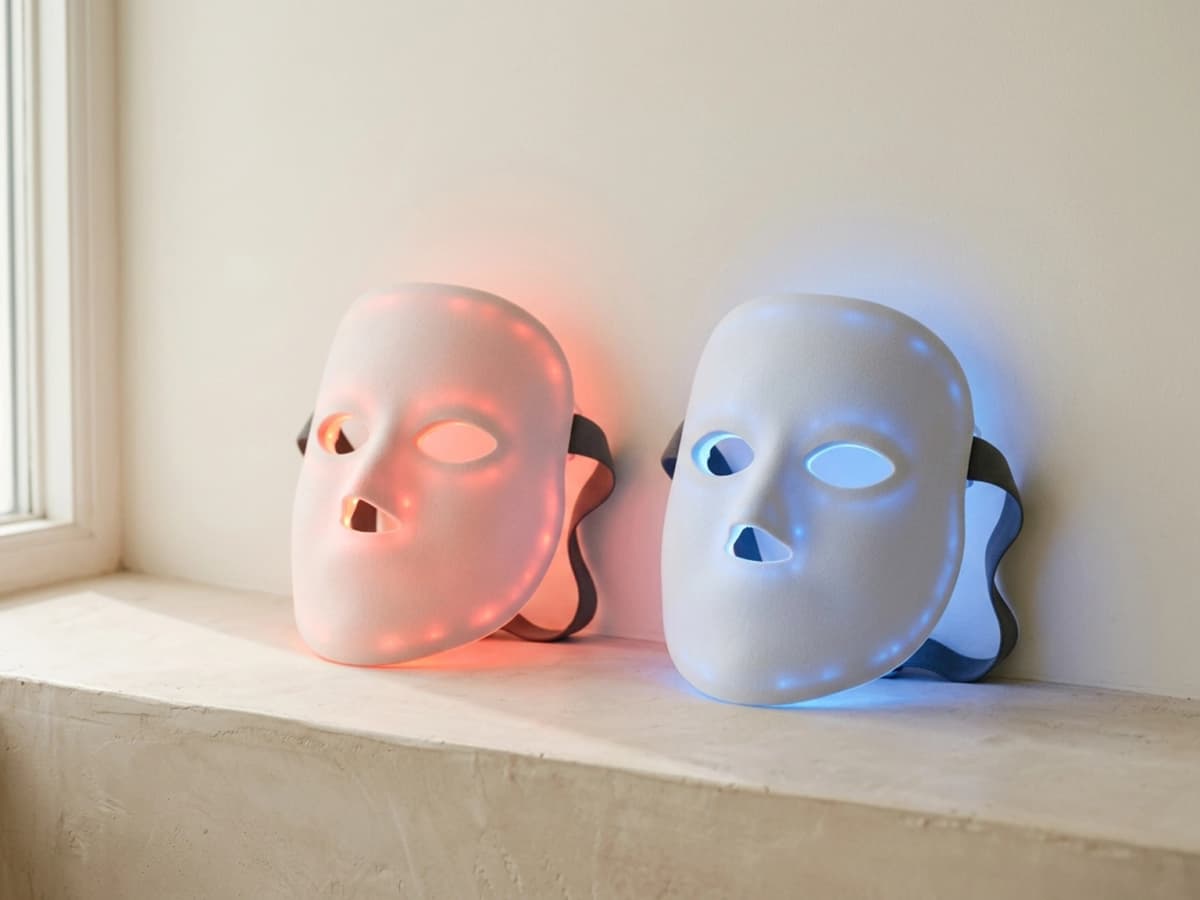
Red Light vs Blue Light: Which LED Mask Do You Actually Need?
Red light and blue light do different jobs at different depths. What the trials show for each, why blue is the only setting with a documented downside, and how to choose.
Do LED Face Masks Actually Work? What the Evidence Says
LED face masks have real clinical evidence for wrinkles and texture — and much weaker evidence for acne. What the trials show, and why irradiance specs mislead.