Red Light vs Blue Light: Which LED Mask Do You Actually Need?
One of these wavelengths is the default. The other is conditional — and it is the only setting on the mask that comes with a documented cost.
Updated July 2026 · 11 min read
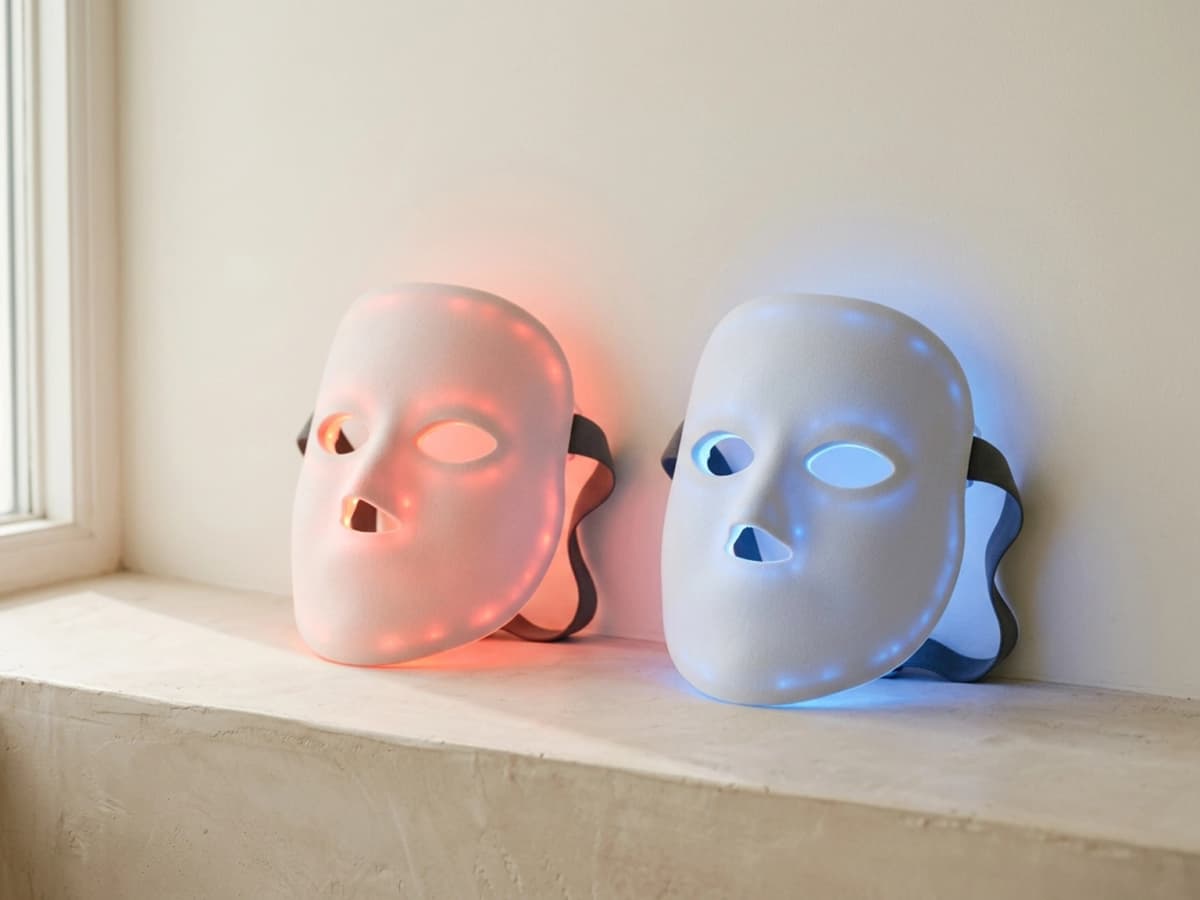
Quick Answer
Bottom line: If you are buying one mask, red plus near-infrared is the default: it carries the strongest photoaging evidence, and red light alone also reduced acne lesions in a controlled trial. Blue is a conditional add-on for active inflammatory acne, and it is the only wavelength with a documented cost — pigmentation in deeper skin tones, and this category's single safety recall. The colour, though, is the second question.
- Red and near-infrared are the broad-spectrum workhorse: the photoaging evidence is strongest here, and red light alone was effective for acne in a 2007 split-face randomised trial
- Blue light's advantage over red for acne is narrow and time-limited: in the cornerstone 2000 trial, blue-red beat blue alone at weeks 4 and 8, but the gap had closed by week 12
- Blue-violet light around 415 nm can trigger long-lasting pigmentation in Fitzpatrick skin type III and above — an effect not observed in types I and II
- The first question is not colour but dose: if a brand publishes neither irradiance (mW/cm²) nor per-session fluence (J/cm²), that silence is the finding
Key Takeaways
- “Blue for acne, red for wrinkles” is a marketing simplification. A 2025 JAMA Dermatology meta-analysis of at-home devices found red, blue and combination devices all efficacious for acne.
- Red light (~633–660 nm) works by photobiomodulation, reaches the dermis, and affects fibroblasts, collagen and sebum. It is the broad-spectrum option.
- Blue light (~415 nm) works photochemically on porphyrins made by acne bacteria and reaches only the epidermis and follicle. It is a narrow specialist.
- Blue's edge over red for acne appears early and does not persist: combined blue-red beat blue alone at weeks 4 and 8 in the 2000 trial, but not at week 12. The two systematic reviews of blue light disagree with each other.
- Blue is the only wavelength with a documented downside: pigmentation via melanocyte opsin-3 in Fitzpatrick III and above, and this category's one recall — a blue-light acne mask, withdrawn in 2019 over eye-injury risk.
- Dose decides more than colour. Consumer masks commonly run 20–40 mW/cm² against 100+ mW/cm² in clinical systems, and many disclose nothing at all.
Short answer: red plus near-infrared is the default wavelength for most people. Blue is the conditional one — worth adding for active inflammatory acne, and the only setting on the mask that carries a documented cost rather than just an unproven benefit.
But the question in the title is the second question. The first is whether the mask in your cart discloses its irradiance at all, because dose — not colour — separates a device that can reach a therapeutic threshold from a glowing prop. If you are still at the earlier question of whether to buy one at all, start with what the evidence says about LED masks overall.
What Each Wavelength Actually Does
Red and blue are not two strengths of the same thing. They act through different mechanisms and stop at different depths — which is why one is a general-purpose setting and the other is not.
Blue light acts photochemically. Around 415 nm it excites porphyrins produced by Cutibacterium acnes, the bacterium involved in inflammatory acne. Those excited porphyrins generate reactive oxygen species, and it is those species — not the light itself — that are bactericidal. Kjeldstad and Johnsson mapped the action spectrum for this in 1986. The mechanism is well characterised, with one hard constraint: blue light is absorbed superficially, reaching the epidermis and the follicle and essentially stopping there.
Red light acts by photobiomodulation. In roughly the 633–660 nm range it is absorbed by mitochondrial cytochrome c oxidase, shifting ATP production and nitric oxide signalling and, in turn, fibroblast behaviour, collagen synthesis and cytokine release. It reaches the dermis — the whole reason red is the wavelength with photoaging evidence behind it.
| Wavelength | Mechanism | Depth reached | Primary target | Evidence |
|---|---|---|---|---|
| Blue ~415 nm | Photochemical — excites bacterial porphyrins, generating reactive oxygen species | Epidermis and follicle only | Inflammatory acne lesions | Contested — two reviews disagree |
| Red ~633–660 nm | Photobiomodulation — cytochrome c oxidase, ATP and nitric oxide signalling | Reaches the dermis | Fine lines, roughness, collagen density; also sebum and inflammation | Strongest of the three |
| Near-infrared ~830 nm | Photobiomodulation — same mechanism as red | Deeper than red | Photoaging, usually paired with red | Almost always tested combined with red |
One detail gets skipped in almost every product description: red light also downregulates sebaceous lipid production and alters macrophage cytokine release. That is why red has an acne effect at all — an anti-inflammatory, sebum-modulating one, entirely separate from anything antibacterial.
Red Light: What the Evidence Supports
Red and near-infrared carry the deepest evidence base in this category, and it is concentrated on photoaging — fine lines, skin roughness, collagen density.
The most-cited controlled trial is Wunsch and Matuschka (2014). A prospective randomised controlled trial of 136 volunteers, treated twice weekly for 30 sessions with either 611–650 nm or 570–850 nm polychromatic light, normalised to approximately 9 J/cm² in the 611–650 nm range. Against 23 controls, treated participants improved significantly on blinded profilometric skin roughness, ultrasonographic intradermal collagen density and complexion. The broadband polychromatic arm showed no advantage over red-only — more wavelengths did not mean more result. One caveat: the control arm used a quartz placebo, not a sham light.
The cleaner design came later. Park, Park and Jung ran a multi-centre, randomised, double-blind, sham-controlled trial in 60 participants of Asian descent, Fitzpatrick types II to V, aged 30 to 65, all with crow’s feet graded 2 to 4. The active device combined a 630 nm LED and an 850 nm IRED, each at a maximum of 10 mW/cm². The protocol was 9 minutes per session, five times a week, for 12 weeks — 60 sessions, 540 minutes of total exposure. Both independent raters and investigators found significant differences in crow’s feet grading at 8, 12 and 16 weeks, with an improvement rate of at least 69.2% (86.2% in the full analysis set, 89.3% per protocol) and a difference from control of at least 49.2% (69.5% and 72.6% respectively).
The sham matters as much as the result. It was identical in appearance, emitted no 850 nm at all, and ran its 630 nm output at one-tenth intensity — so participants could not tell which device they had been given. A double-blind sham-controlled trial of an actual consumer mask is rare here, which is what makes it the anchor rather than the effect size.
The underrated finding: red light alone works for acne. Na and Suh ran a split-face randomised single-blinded trial in 28 people with mild-to-moderate acne, using a portable red-light device for 15 minutes twice daily over 8 weeks, and concluded that red light phototherapy alone is effective for acne vulgaris. No blue involved.
That trial is small and single-blinded, so it settles nothing on its own. But it undercuts the tidy split the category is sold on: red is the broad-spectrum option with a plausible route to both concerns, and blue is the narrow specialist.
Blue Light: What the Evidence Supports, and Where It Stops
Blue light does have real support for inflammatory acne. Its advantage over red, however, is narrower and more time-limited than the marketing implies — and the sharpest illustration sits in the trial the whole category rests on.
Papageorgiou, Katsambas and Chu (2000) randomised 107 people to four arms: blue light at 415 nm, mixed blue and red at 415 and 660 nm, cool white light, or 5% benzoyl peroxide cream. Fifteen minutes daily, 12 weeks. The blue-red arm reached a 76% mean improvement in inflammatory lesions (95% CI 66–87), beat benzoyl peroxide at weeks 8 and 12, and beat white light at every assessment. Comedones improved 58% (95% CI 45–71) with blue-red — better than the other arms, but not significantly so.
Here is the detail that changes how you read the whole category: blue-red was significantly superior to blue light alone at weeks 4 and 8 — but not at week 12. The gap closed by the end of the study. And that 76% belongs to that protocol — 15 minutes daily for 12 weeks at a stated dose — not to any mask on a shelf.
The at-home evidence is genuinely positive and genuinely thin. A 2025 systematic review and meta-analysis in JAMA Dermatology pooled at-home LED devices and found, versus control, a greater percent change of 45.3% in inflammatory lesions (95% CI 25.1–65.5), 47.7% in non-inflammatory lesions (95% CI 18.0–77.4) and 45.7% on investigator global assessment (95% CI 29.1–62.4), with improvement typically noted between 4 and 12 weeks. Adverse reactions were mild — dryness, erythema, or discomfort during treatment. Red, blue and combination devices were all found efficacious. The entire at-home evidence base it drew on is six studies.
And the reviews of blue light disagree with each other. The Cochrane review of light therapies for acne covered 71 randomised trials and 4,211 participants with a median sample size of 31, could not pool results because interventions and outcomes were too heterogeneous, and rated the evidence for participant-assessed global improvement as very low quality. A 2019 meta-analysis in Annals of Family Medicine, focused specifically on blue light, added six trials to Cochrane’s eight and found the mean difference between groups non-significant for both non-inflammatory lesions (MD 3.47; 95% CI −0.76 to 7.71; P=0.11) and inflammatory lesions (MD 0.16; 95% CI −0.99 to 1.31; P=0.78) at weeks 4, 8, 10–12 and overall. Its conclusion: methodological and reporting limitations restrict what can be said about blue light’s effectiveness.
The two are asking different questions of different trial sets, so they are not strictly contradictory. But the honest read is an unresolved evidence base. One more thing worth stating plainly: there is no trial support for a blue-light “purge.” If a device is making you break out, that is a reaction, not a phase — the same distinction that applies to purging versus a genuine breakout.
The Asymmetry Nobody Mentions
Red light’s risk profile is essentially “it might not do much.” Blue light’s is different in kind, and runs in two directions: pigment and eyes.
Melanocytes have a sensor for blue light. Regazzetti and colleagues identified opsin-3 as the receptor: blue-violet light around 415 nm triggers calcium-dependent melanogenesis, ending in tyrosinase and dopachrome tautomerase activity. A tyrosinase/DCT protein complex forms mainly in dark-skinned melanocytes and sustains that activity — the proposed explanation for why long-lasting hyperpigmentation was observed only in skin type III and above. Types I and II showed none at all.
Supporting work points the same way. A 2021 systematic review reports that visible light and UVA1 both induce hyperpigmentation in phototypes IV to VI, with visible-light pigmentation darker and longer-lasting than UVA1’s, and no effect in phototype II. A 2023 study found blue light induced dose-dependent pigmentation in type III–IV skin, with 20 J/cm² producing obvious, long-lasting pigmentation.
The literature is directional rather than unanimous, and all of it comes from experimental irradiation rather than mask trials — so this is a mechanism-supported risk in susceptible skin, not a demonstrated finding that LED masks cause melasma. If you are Fitzpatrick III or above or melasma-prone, it is still enough to treat blue as optional rather than default, and to keep daily sunscreen applied properly in the routine regardless.
The second direction is eye safety, and it has a paper trail. In July 2019 Neutrogena voluntarily recalled its Light Therapy Acne Mask — a blue and red device — citing a theoretical risk of eye injury for a small subset of people with certain underlying eye conditions and for users on medications that enhance ocular photosensitivity. Reported adverse reactions included transient eye pain or irritation, tearing, blurry vision, seeing spots and changes in colour vision. The product was discontinued.
Regulators treated it as more than a formality. Health Canada logged it as a Type II medical device recall, and the Australian Department of Health issued a consumer-level recall advising all users to stop immediately, citing possible irreversible retinal damage and accelerated peripheral vision loss in susceptible people — those with retinitis pigmentosa, ocular albinism or other congenital retinal disorders.
The photosensitising medication named in reporting on that recall was doxycycline — an oral antibiotic routinely prescribed for acne. Which means the population most likely to reach for a blue-light acne mask overlaps directly with the population flagged as higher-risk. That overlap is the part nobody puts on the box. The same logic applies to topical ingredients that raise light sensitivity.
None of this makes blue light unusable. It makes it conditional — and it makes the eye-protection instructions something to follow rather than skim. If you take a photosensitising medication or have a diagnosed retinal condition, that is a conversation to have with your doctor before you buy, not after.
Near-Infrared: The Third Option on the Box
Near-infrared, usually around 830 nm, is not a separate mechanism — it is photobiomodulation, the same process as red light, at a wavelength that penetrates further. That is its entire pitch, and it is a reasonable one.
What it is not is independently evidenced. Near-infrared is almost always tested alongside red rather than against it, including in the sham-controlled home-mask trial above, which paired 630 nm with 850 nm. So red plus near-infrared is a sensible default with trial support behind the combination — but there is no basis for paying a premium for near-infrared as a standalone upgrade.
Dose, Not Colour, Is What Decides It
Two numbers determine whether any wavelength does anything: irradiance, the optical power delivered per unit area in mW/cm², and fluence, the total energy per session in J/cm². Colour without dose is a specification that cannot be evaluated.
Consumer masks commonly run around 20–40 mW/cm², against 100+ mW/cm² in clinical systems — and many disclose neither figure. A pilot study measuring actual wavelength output and irradiance across consumer home-use photobiomodulation devices found wide variation, which means published specs and delivered output are not the same claim.
Worth sitting with: the best sham-controlled home-mask trial in this category ran its LEDs at a maximum of 10 mW/cm² — below the 20–40 mW/cm² typical of consumer devices, and far below clinical panels. That is one trial and is not a target to shop for. But it sharpens the point rather than softening it: what produced a measurable result was a disclosed output paired with a real protocol — 9 minutes, five times a week, for 12 weeks — not a large irradiance number.
Higher is not the goal, though. Photobiomodulation follows a biphasic dose response: below the effective window nothing happens, and above it the response is suppressed rather than amplified. The doses that produced results in the trials cited here were modest — roughly 9 J/cm² per session, twice weekly, for the photoaging protocol, and roughly 3.8 J/cm² per session for the acne protocol, arrived at from 4.23 mW/cm² over 15 minutes. Both used low irradiance over longer durations, which is also why how often you use the mask matters more than how powerful it is.
What to do with that when you shop:
- Look for irradiance in mW/cm² and per-session fluence in J/cm² on the spec sheet, not just a wavelength list.
- Check whether the irradiance figure states a measurement distance. A number taken at skin contact is not comparable to one taken six inches away.
- Compare the stated per-session dose against the trial anchors: roughly 9 J/cm² twice weekly for photoaging, roughly 3.8 J/cm² daily for acne.
- If a brand publishes neither number, stop there. That silence is the finding, and it is more informative than any wavelength count.
One label to read correctly while you are there: LED masks are FDA cleared, not FDA approved. Clearance runs through the 510(k) pathway and means the agency determined the device is substantially equivalent to something already on the market. It is a safety signal. It is not a finding that the device produced a result in a trial.
How to Choose (Based on Your Case)
If
Fine lines, texture, or general prevention
Red + near-infrared
Because: This is where the photoaging evidence sits, including the one double-blind sham-controlled trial of a home-use mask. Blue adds nothing for this goal.
If
Active inflammatory acne, Fitzpatrick I–II
Red + blue
Because: Combined blue-red is the protocol the cornerstone acne trial tested, and induced hyperpigmentation was not observed in skin types I and II.
If
Active acne, Fitzpatrick III–VI, or melasma-prone
Red-only, or blue sparingly
Because: Blue-violet light around 415 nm can trigger long-lasting pigmentation from skin type III upward. Red light alone was effective for acne in a controlled trial, so the red-only route is not a compromise. If you use blue, keep tinted mineral sunscreen in the routine.
If
Comedonal acne only — blackheads and whiteheads
Light is the wrong tool
Because: Comedones improved least in the trials, and not significantly. This is a topical job, and a well-chosen exfoliating acid is a better starting point than a device.
If
On doxycycline, isotretinoin or any photosensitising medication, or living with a retinal condition
Talk to your doctor first
Because: These are exactly the groups named in the 2019 blue-light mask recall. This is a medical conversation, not a shopping decision.
For the comedonal case specifically, the useful reading is how AHAs and BHAs differ and which suits clogged pores, not a wavelength comparison.
Frequently Asked Questions
Can I use red and blue light in the same session?
Yes. The cornerstone acne trial tested exactly that combination — mixed blue and red light at 415 and 660 nm in a single session — rather than alternating them, so combining is the studied approach. What no trial supports is stacking two separate sessions in one day, which adds blue-light exposure without adding known benefit.
How long until I see results from an LED mask?
Published protocols run in months, not days. The sham-controlled home-mask trial used 12 weeks of sessions — 9 minutes, five times a week — and found significant differences at 8, 12 and 16 weeks. The photoaging panel trial ran 30 sessions, twice weekly. The meta-analysis of at-home acne devices found improvement typically noted between 4 and 12 weeks. Claims of visible change within a week are not supported by trial data for either wavelength.
Do I need goggles with an LED face mask?
Follow the eye-protection instructions that ship with the device, and treat them as non-negotiable with blue light. The one high-profile recall in this category — Neutrogena's Light Therapy Acne Mask, July 2019 — was withdrawn over a theoretical risk of eye injury for people with certain underlying eye conditions and users on medications that increase ocular photosensitivity. Anyone with a retinal condition should ask an ophthalmologist first.
Is daily use better than a few times a week?
Not necessarily. Photobiomodulation follows a biphasic dose response: below the effective window nothing happens, and above it the response is suppressed rather than amplified. The protocols that produced published results used modest per-session doses — roughly 9 J/cm² twice weekly for photoaging, roughly 3.8 J/cm² daily for acne — not maximal ones.
Does an LED mask replace my retinoid or benzoyl peroxide?
No. In the 2000 blue-red trial, combined light beat 5% benzoyl peroxide on inflammatory lesions at weeks 8 and 12 — but that is one comparison, in one trial, against one concentration. Retinoids, benzoyl peroxide and daily sunscreen remain the interventions with the deepest evidence base, and an LED mask sits alongside them rather than in place of them.
Final Thoughts
The clean split the category sells — blue for acne, red for wrinkles — does not survive contact with the trials. Red is the broad-spectrum wavelength with the deepest evidence and a route to both photoaging and acne. Blue is a specialist with a real but narrow effect, an unresolved review literature, and the only documented downside here.
So the default is red plus near-infrared, with blue added conditionally if inflammatory acne is the target and your skin type and medications make it a reasonable trade. And before any of that, the question that actually filters the market: does this brand publish its irradiance and per-session dose? Everything else is a colour chart. To compare specific models on exactly those terms, our LED face mask comparison covers wavelengths, treatment times and what each brand does and does not disclose. Whichever you choose, it sits alongside proven topicals like a retinoid used correctly and daily sunscreen, never in place of them.
This article is for informational purposes and is not medical advice. Individual results vary. Consult a qualified healthcare professional before starting light therapy, particularly if you are pregnant, take photosensitising medication, or have a diagnosed eye or skin condition.
Sources
- [1]Ershadi S, Barbieri JS. Efficacy of at-home light therapy devices for acne vulgaris: a systematic review and meta-analysis. JAMA Dermatol. 2025;161(5):552–555. View source
- [2]Papageorgiou P, Katsambas A, Chu A. Phototherapy with blue (415 nm) and red (660 nm) light in the treatment of acne vulgaris. Br J Dermatol. 2000;142(5):973–978. View source
- [3]Na JI, Suh DH. Red light phototherapy alone is effective for acne vulgaris: results of a single-blind, randomized, controlled clinical trial. Dermatol Surg. 2007;33(10):1228–1233. View source
- [4]Wunsch A, Matuschka K. A controlled trial to determine the efficacy of red and near-infrared light treatment in patient satisfaction, reduction of fine lines, wrinkles, skin roughness, and intradermal collagen density increase. Photomed Laser Surg. 2014;32(2):93–100. View source
- [5]Park SH, Park SO, Jung J-A. Clinical study to evaluate the efficacy and safety of a home-used LED and IRED mask for crow's feet: a multi-center, randomized, double-blind, sham-controlled study. Medicine (Baltimore). 2025;104(7):e41596 (PMID 39960921). View source
- [6]Regazzetti C, Sormani L, Debayle D, et al. Melanocytes sense blue light and regulate pigmentation through opsin-3. J Invest Dermatol. 2018;138(1):171–178. View source
- [7]Chauhan S, Jaiswal S, Jakhar V, et al. Combination of visible light and ultraviolet A1 in dermatology: a systematic review of the effects on pigmentation. Photochem Photobiol. 2021. View source
- [8]Li W, Liu C, Chen S, et al. Blue light induces dose-dependent pigmentation in Fitzpatrick skin type III–IV. Skin Res Technol. 2023. View source
- [9]Ranpariya V, et al. A cross-sectional analysis of at-home LED mask content on TikTok. J Cosmet Dermatol. 2025. View source
- [10]Cronshaw M, Parker S, Grootveld M, et al. Wavelength output and irradiance variability across consumer home-use photobiomodulation devices: a pilot study. Dent J (Basel). 2025. View source
- [11]Scott AM, Stehlik P, Clark J, et al. Blue-light therapy for acne vulgaris: a systematic review and meta-analysis. Ann Fam Med. 2019;17(6):545–554. View source
- [12]Barbaric J, Abbott R, Posadzki P, et al. Light therapies for acne: abridged Cochrane systematic review including GRADE assessments. Br J Dermatol. 2018;178(1):61–75. View source
- [13]Maghfour J, Ozog DM, Mineroff J, et al. Photobiomodulation CME Part I: overview and mechanism of action. J Am Acad Dermatol. 2024. View source
- [14]Kjeldstad B, Johnsson A. An action spectrum for blue and near ultraviolet inactivation of Propionibacterium acnes; with emphasis on a possible porphyrin photosensitization. Photochem Photobiol. 1986;43(1):67–70. View source
- [15]Neutrogena. Light Therapy Acne Mask recall statement, July 2019. View source
- [16]Health Canada. Health product recall — Neutrogena Light Therapy Acne Mask and Light Therapy Acne Mask Activator (Type II, initiated 2 July 2019). View source
Keep Reading
How Often Should You Use an LED Mask? (And When You'll See Results)
Most trials that reported results used an LED mask 2–3 times a week. What the evidence says about frequency by goal, and how long change actually takes.
Budget LED Face Masks Under $150: Do the Cheap Ones Work?
A cheap LED mask can work in principle — dose is irradiance × time. The catch: under $150, the specs don't let you compute the dose. Here's what we found.
Do LED Face Masks Actually Work? What the Evidence Says
LED face masks have real clinical evidence for wrinkles and texture — and much weaker evidence for acne. What the trials show, and why irradiance specs mislead.