SPF
Retinol + Sunscreen: The Combo You Can't Skip in Summer
Retinol does not make your skin burn more easily — that part is folklore. The reason you still cannot skip SPF is better than the myth, and it is circular.
Updated August 2026 · 7 min read
Retinol does not make your skin burn more easily — that part is folklore. The reason you still cannot skip SPF is better than the myth, and it is circular.
Updated August 2026 · 7 min read

Quick Answer
Bottom line: Retinol is not a photosensitizer — it does not raise your skin's UV sensitivity the way alpha hydroxy acids do. Sunscreen is still non-negotiable, because UV drives the collagen breakdown that retinol is documented to repair. Skip SPF and you pay to undo damage you are actively creating. Retinol at night, broad-spectrum SPF 30+ every morning, year-round.
In this guide
The usual version of this advice goes: retinol makes your skin sun-sensitive, so wear sunscreen. The second half is right. The first half is not.
Topical retinoids are not established photosensitizers. Retinol does not raise your skin's sensitivity to ultraviolet light the way alpha hydroxy acids do, and there is no retinol equivalent of the measured sensitivity increase documented for AHAs. Our guide to the ingredients people are told to avoid in the sun sorts retinoids into a different bucket entirely, and the distinction changes what you do about them.
The conclusion survives anyway. You cannot skip sunscreen while using retinol — for a reason that is sharper than the myth it replaces, and slightly absurd once you see it. Retinol's documented job is repairing the damage that UV causes. Skip the SPF and you are funding both sides of the same fight.
Dermatology consensus is that topical retinoids — tretinoin, adapalene, tazarotene, and over-the-counter retinol — are not established drug-induced photosensitizers. That is the single most repeated claim about retinol and the sun, and it does not hold up as a mechanism.
So where did the warning come from? The sun cautions on retinoid packaging are best explained by irritation rather than photosensitization. Retinoid dermatitis — the dryness, flaking, pinkness, and stinging that shows up in roughly the first two to four weeks — leaves skin reactive and uncomfortable, and reactive skin does not do well in strong sun. A manufacturer writing a package insert has every reason to say "minimize sun exposure." That is sensible advice built on the wrong stated mechanism.
The distinction is not academic, because the two mechanisms point to different responses. A genuine photosensitizer raises your UV vulnerability by a quantifiable amount and needs sunscreen to compensate for it. Retinoid irritation is a temporary state you manage with a slower ramp, a buffering moisturizer, and time — and it resolves as skin adjusts.
What this does not mean: that you can skip sunscreen. It means the reason to wear it has nothing to do with retinol burning you. There is no phototoxic reaction between retinol and daylight, and no measured percentage by which retinol raises your risk of sunburn. Anyone quoting you one is inventing it.
None of these is "retinol makes you burn." The first one is the strongest, and it is the reason dermatologists treat the pair as inseparable.
Start with what UV actually does. Work published by Fisher and colleagues in the New England Journal of Medicine in 1997 showed that a single ultraviolet exposure raises matrix metalloproteinases in skin — collagenase, gelatinase, and stromelysin, the enzymes that break collagen down. Repeated exposure keeps them elevated. The downstream result is the familiar picture of photoaging: wrinkles, altered pigmentation, and loss of tone.
Now look at what retinol is for. Tretinoin has been shown to restore collagen formation in photodamaged skin (Griffiths and colleagues, NEJM, 1993). Kang and Voorhees' review in the Journal of the American Academy of Dermatology anchors topical retinoids as a treatment for photoaging specifically. Retinol itself has been shown to improve naturally aged skin (Kafi and colleagues, Archives of Dermatology, 2007). The category's headline benefit is repairing the damage the paragraph above describes.
UV causes photoaging. Retinol treats photoaging. Using retinol without sunscreen means paying to repair damage you are simultaneously paying to create — rowing hard in both directions and wondering why the boat has not moved.
The same Fisher work points the other way too: retinoic acid applied before UV exposure substantially reduced the UV-induced AP-1 and MMP response, meaning tretinoin blunts the collagen-degradation cascade rather than merely cleaning up afterward. That makes sunscreen and retinoid complementary rather than redundant. It also explains why patience matters — retinoid benefits for photoaging generally take around three to six months of daily use to become visible, which is a long time to spend undoing your own progress every afternoon. Our week-by-week look at how long retinol really takes sets realistic expectations for that timeline.
Retinoids degrade under light, and UVA is the major contributor to that photodegradation. The effect is well documented for tretinoin in particular: a conventional tretinoin 0.025% gel degraded by roughly 72% under eight hours of UVA exposure, while a micronized 0.05% formulation degraded by only about 9%. Those figures are specific to those tretinoin formulations and should not be read as retinol numbers — but they are the documented basis for the evening-application rule that applies across the category. Retinol is likewise light-sensitive.
Two honest caveats keep this from being overstated. First, the degradation that matters happens mainly before absorption and in storage — once retinol has absorbed into skin, its efficacy is retained. This is a formulation-and-timing concern, not a reason to think daylight is undoing the retinol already in your skin.
Second, and this is the part people get backwards: putting sunscreen on top of retinol does not protect it. When Brisaert and Plaizier-Vercammen tested filters over topical tretinoin, a UV-B filter did not retard breakdown and a UV-A filter had little effect. Sunscreen protects your skin. It is not a lid for your actives. Night application is the fix.
While skin is adjusting to a retinoid, the barrier is temporarily compromised and surface skin is turning over faster. Skin in that state is more easily damaged by UV — not because retinol changed how your skin responds to light, but because some of its physical defenses are briefly thinner.
Read this one carefully: this is a qualitative effect, not a quantified photosensitivity finding. There is no measured retinol equivalent of the AHA sensitivity figure, and presenting one would be inventing evidence. The point is directional, and the response is practical.
The fix is sunscreen plus a gradual ramp — not avoiding retinol. Building tolerance slowly keeps the irritation phase short and mild, which is most of what determines whether beginners stick with the ingredient at all. Choosing a starter retinol serum with barrier support built in makes that stretch considerably easier.
Not the rules — only the stakes. Dermatology consensus is that retinoids can be used safely year-round, including summer, provided daily sun protection is part of the routine. "Stop retinol for the summer" is the second myth in this article, and it is more expensive than the first, because stopping and restarting means running the irritation phase all over again in September.
What summer genuinely changes is the volume of UV your skin meets, which raises the value of the sunscreen half of the pair — more reapplication, more shade, more attention on the days you are outdoors for hours. It does not make retinol unsafe. Your skin cells do not have a calendar; they respond to how much ultraviolet light reaches them.
The one real exception: pause retinol if your skin is actively inflamed or irritated. Sun exposure worsens active irritation and the pigmentation that can follow it. That is a skin-condition trigger, not a seasonal one — it applies in January too.
Otherwise the summer routine looks like the winter routine with more diligence attached to the morning step. If your sunscreen is the reason you skip it, that is worth solving directly — our roundup of fragrance-free sunscreens for sensitive skin covers formulas that are easier to wear daily, and how much sunscreen to actually apply matters more than which bottle you picked.
The whole protocol fits in a sentence: retinol at night, broad-spectrum SPF 30 or higher every morning, and do not stop for the season. The details below are what keeps that sustainable.
If
You are in the first few weeks of retinol and your skin is pink, flaking, or tight
Keep the retinol, slow the pace, add moisturizer and daily SPF
Because: the reactivity is retinoid irritation rather than photosensitivity, and it settles as skin adjusts — a gradual ramp addresses it without giving up the ingredient
If
Your skin is actively inflamed or genuinely irritated right now
Pause retinol until it calms down
Because: sun exposure worsens active irritation and the pigmentation that can follow it — this is the one real reason to take a break
If
It is peak summer and you are outdoors for hours most days
Continue retinol at night and reapply sunscreen through the day
Because: higher UV raises the value of sun protection rather than making retinol unsafe; retinoids can be used year-round with daily sun protection
If
You are pregnant or trying to conceive
Stop topical retinoids and talk to your doctor
Because: topical retinoids are contraindicated in pregnancy, and that has nothing to do with sun exposure
Not in the way the phrase implies. Topical retinoids are not established photosensitizers, so retinol does not raise your skin's UV sensitivity the way alpha hydroxy acids do. What retinol can do, especially in the first few weeks, is irritate skin and disrupt the barrier — and skin in that state burns more easily. The practical answer is the same either way: wear broad-spectrum sunscreen daily.
Yes. Dermatology consensus is that retinoids can be used year-round, including summer, provided you use daily sun protection. Higher summer UV raises the stakes on protecting your skin, but it is not a reason to stop the retinol. The one real exception is active irritation: if your skin is currently inflamed, pause until it settles.
No. Retinol is a PM step and sunscreen is an AM step, and layering SPF over retinol does not shield it. When researchers tested sunscreen filters over topical tretinoin, a UV-B filter did not retard breakdown and a UV-A filter had little effect. Applying retinol at night is what protects it, not adding sunscreen on top.
Light does degrade retinoids, with UVA identified as the major contributor to photodegradation — which is exactly why retinol is sold and used as a nighttime product. That degradation matters mainly before the product absorbs and while it sits in storage. Once retinol has absorbed into skin, its efficacy is retained.
Yes. Sunscreen reapplication is about the UV hitting your skin during the day, and that is independent of when you apply retinol. The American Academy of Dermatology recommends daily broad-spectrum, water-resistant SPF 30 or higher for everyone, reapplied through the day, whether or not retinol is in your routine at all.
Disclaimer: This content is for informational purposes only and is not medical advice. Individual results may vary. Always patch test new products and consult a dermatologist for specific skin concerns.
Retinol does not make you sun-sensitive. It is not a photosensitizer, there is no phototoxic reaction waiting for you in daylight, and no honest source can give you a percentage. The warning label was describing irritation and got translated into a mechanism it never had.
Skipping sunscreen is still the fastest way to waste a retinol routine. UV drives the collagen breakdown that retinoids are documented to repair, so an unprotected morning quietly cancels the work of the night before. That is a better argument than the myth, and it survives the correction.
Retinol at night. Broad-spectrum SPF 30 or higher every morning, reapplied. Do not quit for summer — pause only if your skin is actively irritated, and pick it back up when it settles.
Where to go next on retinol and sun protection.
Keep Reading
5 Skincare Ingredients You Should Never Wear in the Sun (And the One Everyone Gets Wrong)
'Never wear in the sun' means three different things. Here's which ingredients truly need daytime avoidance, which just need SPF, and the one myth to drop.
Best Sunscreens for Sensitive Skin on Amazon
Fragrance-free, dermatologist-approved sunscreen picks for sensitive, acne-prone, and eczema-prone skin — from $13 to $45.
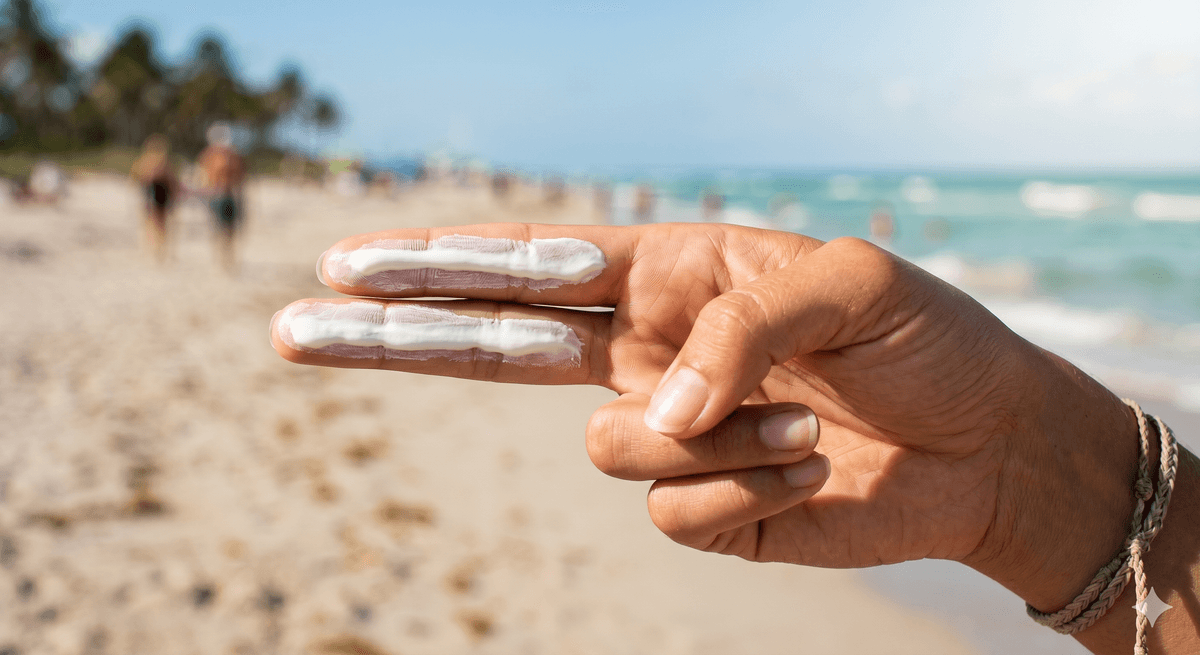
How Much Sunscreen Should You Apply to Your Face?
The standard recommendation is about 1/4 teaspoon for the face alone. Here is what that looks like in practice, why the amount matters for SPF accuracy, and how to reapply correctly.